

Treasury Bonds Explained: Why Yield to Maturity Determines What You Pay, Not What You Earn
Coupon Rate vs Yield to Maturity:

How Investors Lose Millions in Treasury Bonds Without Understanding Yield to Maturity. The People who paid 8.5% premium on the 10 Year Bond.
When it comes to treasury bonds, this is what we call a fixed income investment. It is referred to as “fixed income” because, at the point when you buy a treasury bond, you already know how much you are going to earn every single year. It is like someone telling you that for every UGX 10,000,000 invested, you will earn UGX 1,440,000 annually.
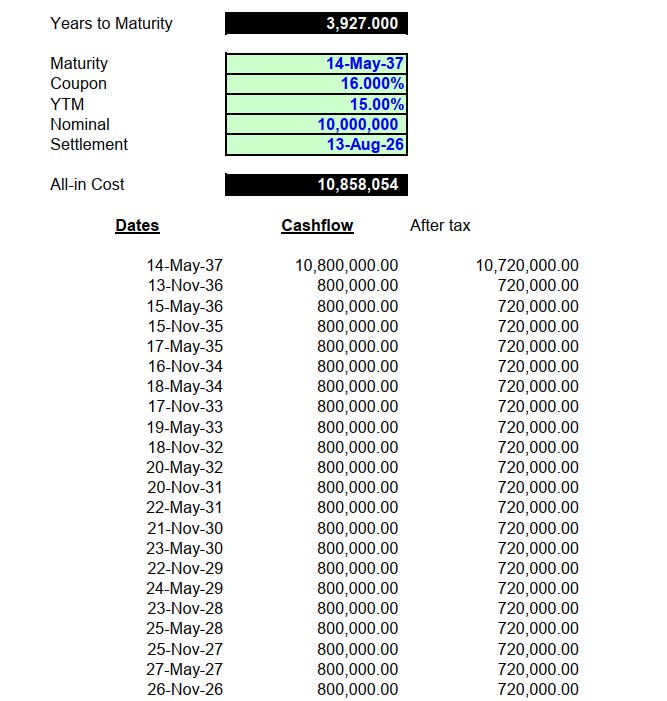
Cashflow mapping of the 10 Year Bond Bought by a client from the primary market today.
In treasury bonds, this return is not expressed as a flat amount but as a percentage, and that percentage is what determines the cash flow you will receive. To understand this more clearly, it helps to compare treasury bonds with other types of investments.
For example, consider land. If you buy a plot of land for UGX 10,000,000 and, after five years, its value increases to UGX 15,000,000, someone would say that you have made a 50% profit, or a 50% capital gain, over those five years (8.5% CAGR). However, when you initially bought that land, you did not know exactly what you were going to earn. You simply believed it would make money for you. The reality is that it could make more or less than expected.
You cannot buy land today at UGX 30,000,000 and confidently tell people that in three years it will be worth UGX 50,000,000. You might list it on the market at UGX 50,000,000 and fail to find a buyer, or you might even find someone willing to offer UGX 70,000,000. That is because the return on land is not fixed; it varies greatly depending on several factors such as location, how far it is from the road, the quality of the land, the developments around it, who your neighbors are, and how much you have invested in improving it. All these factors influence the final value.
With treasury bonds, however, the situation is different. You are certain about the Coupon rate at the time of purchase. If you buy a 10-year bond, you already know the cash flow you will receive every year over the life of the bond. The coupon rate is the interest rate given on the bond and represents the amount you will earn annually, however, even though it is expressed as an annual rate, the payments are made twice a year, typically every six months.
For example, consider a treasury bond such as the 2037 bond, which is a 10-year bond right now on the run. If it has a coupon rate of 16%, that 16% represents the annual cash flow you will earn on your investment in UGX before tax.
This means that over the remaining life of the bond, whether it is 10 or 11 years, you will consistently earn that 16% every year. However, the government does not pay this in one lump sum at the end of the year. Instead, they pay it in two equal installments, each representing half of the annual 16%, computed based on that coupon rate. This coupon rate never changes, and that is what makes treasury bonds a true fixed income investment.
However, when you are buying a bond, the most important thing to focus on is not just the coupon rate but the amount you actually pay. The key point here is the amount you pay, because that is determined by what we call the yield to maturity (cut off yield in Primary Market). The yield to maturity is the interest rate that changes every single day in the market, and it is what determines the price you pay for the bond.
To make this easier to understand, think again about land. Imagine you go to an estate to buy a 50 by 100 plot of land. You and another buyer are looking at identical plots, with no difference at all. You buy your plot today when there are still many plots available, and the seller gives it to you at UGX 25,000,000. Two days later, another buyer comes when only a few plots are left, and the seller now asks for UGX 27,000,000 for the same type of plot. In another situation, you might negotiate well and secure it at UGX 25,000,000, while someone else who does not inquire or negotiate properly could end up paying even more for that same plot. The asset is the same, but the price differs depending on timing, negotiation, and knowledge.
This is exactly how treasury bonds work through the yield to maturity. The yield to maturity determines what you pay for the bond. For instance, Look at the 10 year bond sold in the primary market yesterday with a face value of UGX 10,000,000 and a coupon rate of 16%, one investor who understands the market got a cut off yield of 15% and ended up paying over 10.8 million in cash for this bond. Another investor who does not understand how yields work might accept a yield to maturity of 14.7% in the secondary market and end up paying about UGX 11,00,000 for the very same bond (Face value of 10 million).
Cashflow mapping of the potential 10 Year Bond Bought by a client from the secondary market today at YTM of 14.7%
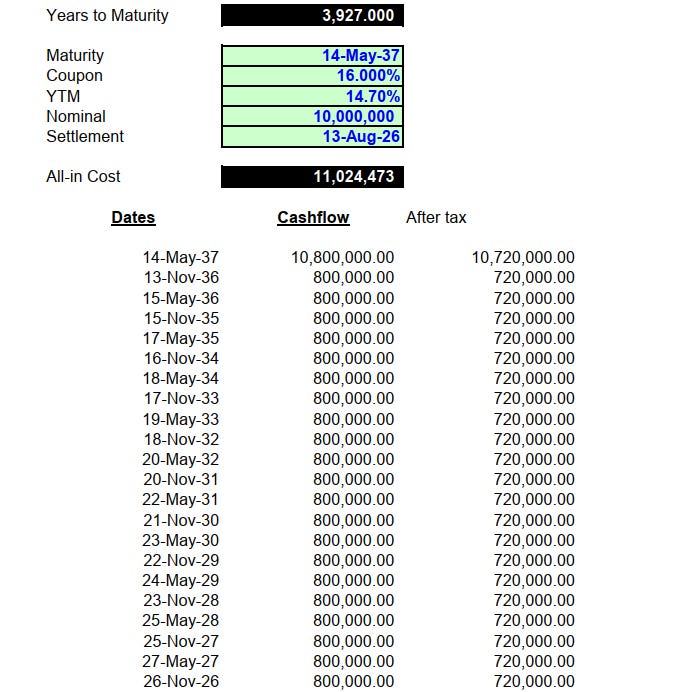
In this scenario, both investors have bought a bond of UGX 10,000,000 and will earn the same coupon income based on the 16% rate. However, one has paid about UGX 800,000 more, while the other has paid about UGX 1,000,000 extra for exactly the same investment. The only difference is the yield to maturity at which they purchased the bond.
Now imagine scaling this up. If instead of UGX 10,000,000 you are investing UGX 50,000,000 or even UGX 100,000,000, the difference in what you pay becomes very significant. This is why understanding yield to maturity is extremely important. While the coupon rate determines your fixed annual income in UGX, the yield to maturity determines the price you pay to access that income, and ultimately affects the overall value of your investment.
To demonstrate this clearly, let us use a larger amount of money, because when you hear UGX 800,000, you might feel like it is not significant. But imagine you are investing UGX 100,000,000. That means you could end up paying UGX 11,000,000 more compared to someone who understands the market, negotiates better, and secures a yield to maturity that’s better, ending up paying only about UGX 8,000,000 extra for the same type of Bond. This creates a very large difference between investors, even though both of you have bought the same bond and will receive the same cash flows over time.
As you enter into treasury bond investments, you need to clearly separate two important concepts. The coupon rate is what determines what you get paid. It defines your fixed income and the cash flows you will receive, and it never changes over the life of the bond. On the other hand, the yield to maturity determines what you pay. This is the rate that changes every single day in the market, and it directly affects how much money leaves your pocket when you are buying the bond.
When you fully understand how these two rates work together, you begin to see the importance of the yield to maturity in guiding your decisions. Again, let us return to the land example because it is easier to visualize.
Because of this, whenever you are buying a bond, you must always ask what the yield to maturity is. If you are buying from the secondary market, negotiate the yield upward where possible, or work with someone knowledgeable who can guide you. The higher the yield to maturity you secure, the less money you will pay for the same bond.
That is the key principle. The more you negotiate a higher yield to maturity, the more you reduce the amount of money you pay, and ultimately, the better your investment position becomes.
Happy Investing Everyone
Alex Kakande
“Dear Bank of Uganda Team, this platform, along with many others, has been created to help retail investors learn and invest more effectively in Treasury Bonds. Restricting our access to timely information while empowering institutional investors risks failing to recognize the strong demand and the important role retail investors have played over the past three years”
How can a retail, non-competitive bidder guestimate the YTM value?
Can Retail investors negotiate the YTM or we just go with whatever comes